Company Savings Without Layoffs: Focus on Innovation
Learn how to find savings in your company without staff reductions. Leverage bottom-up innovation and employee knowledge to realistically lower operating costs.
Why Traditional Cost-Cutting Usually Fails?
When the spreadsheet in the boardroom starts glowing red, the classic reflex is often as refined as fixing a watch with a hammer: a decision is made to reduce headcount by ten percent. On paper, the balance sheet immediately straightens out, the CFO receives congratulations, and three months later, the same company pays recruitment agencies double rates, desperately trying to pull machine operators and logistics specialists back from the market, without whom order fulfillment has ground to a halt.
Research published in the Harvard Business Review shows that over 70% of enterprises that opted for sharp staff reductions to improve profitability record a noticeable drop in productivity and a drastic increase in operating costs over the following three years. Arbitrary cuts destroy the company's fabric for three specific reasons:
- Along with the laid-off people, tribal knowledge of how processes actually work—rather than how they appear in company procedures—evaporates forever.
- In the team that remains on board, survival mode kicks in: no one will risk a new idea because a mistake could cost them their job.
- The workload does not decrease by a single gram, resulting in a plague of sick leaves, picking errors, and contractual penalties from customers.
Instead of cutting the people who generate value, it is much safer to cut the friction that shamelessly wastes that value. It is worth checking how improving existing processes can support these efforts.
Where is Real Money Leaking on the Shop Floor and in the Warehouse?
A CEO rarely knows that at the other end of the warehouse, a forklift covers four kilometers of empty runs daily just because the fastest-moving goods are located in the furthest corner of Sector C. However, Janusz knows this—he has been driving that forklift for six years and curses under his breath every morning at this archaic rack layout.
According to experts from the Lean Enterprise Institute, hidden waste in operational processes, referred to in Japanese Lean methodology as Muda, can consume from 25% to even 40% of the total labor time of the crew. In practice, the most common cash leaks at the intersection of operations and finance are hidden in three areas:
- Consumables and packaging: using stretch film that is too thick, oversized boxes, and unnecessary fillers, which generate thousands of dollars a month in the trash can alone.
- Unnecessary technological downtime: lack of small spare parts at hand, forcing a mechanic to take twenty-minute trips to a distant central warehouse for a single gasket.
- Chaos in tool orders: situations where every shift orders its own power tools because no one keeps an inventory of shared equipment.
How to Implement a Mechanism That Turns Staff Ideas into Profit?
Most corporate rationalization programs end their lives at the same point: a tin box labeled "Employee Ideas" hung next to the smoking area or another popular spot gathers dust, while inside, only used coffee caps and anonymous notes about the need to replace toilet paper end up.
A report by McKinsey & Company on manufacturing transformations shows that continuous improvement programs driven by front-line employees bring 30% more sustainable financial results than programs imposed top-down by external consultants. However, for an employee to want to share their knowledge, the system must meet strict rules of the game:
- Transparent decision path: every submitted proposal must receive a binding operational response in no more than 7 business days.
- Tangible financial gratification: if an operator's idea saves the company $20,000 a year on energy consumption in a hardening furnace, the author of the innovation should receive 10% to 15% of that amount as a direct bonus.
- Right to small-scale experimentation: permission to test an idea on one workstation for two weeks without having to create a hundred-page presentation for an investment committee.
When the crew sees that reporting an error results in improved working conditions and extra cash in their account, rather than a reprimand from the foreman, the organizational culture changes from passive waiting for the bell to authentic concern for the company's financial result. Business process optimization using gamification can be helpful here.
How to Connect a Shop Floor Idea with the Boardroom Excel?
The biggest barrier to implementing bottom-up savings is not a lack of employee creativity, but analytical inertia. An operations director hears: "let's change the tape supplier to a thinner one," but has no time to calculate how this modification will affect the complaint rate for damaged shipments over the next two quarters.
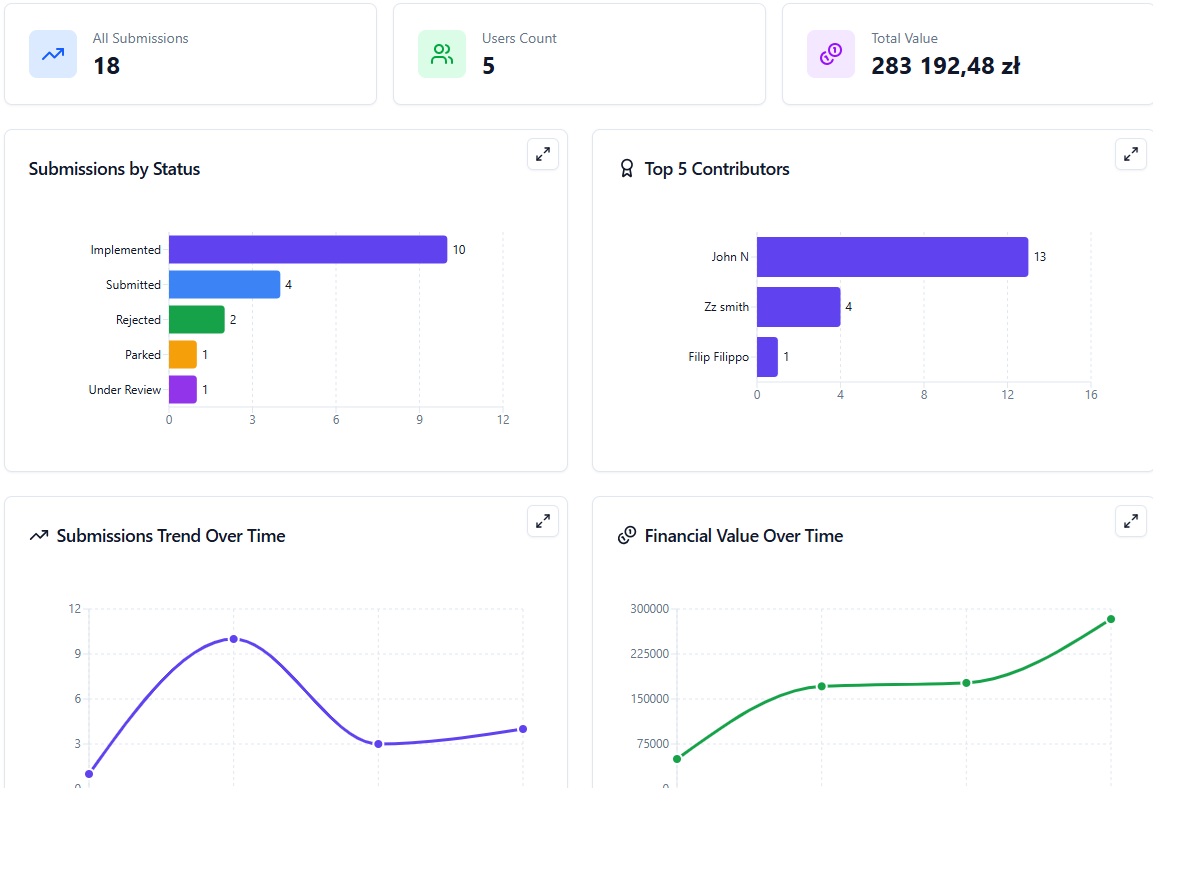
This is where automation becomes essential. By using a dedicated analytics platform, an enterprise gains the ability to track unit costs in real-time before the innovation is implemented and after its approval. You see in black and white whether the crew's proposal brought the declared savings of $10,000 or perhaps generated a hidden cost in another department.
Instead of guessing and risking the morale of the entire enterprise with another wave of nervous personnel cuts, check Costwise.pro and see how well-designed software helps achieve above-average profits generated by optimizations that, until now, leaked irretrievably through leaky operational procedures.
FAQ
Should the bonus for a submitted savings idea be fixed or percentage-based?
A mixed model works best, where small workstation improvements are rewarded with a fixed cash amount paid immediately after implementation. Large process innovations should be settled as a share of realistically documented savings from the first six or twelve months.
How to convince middle management not to block staff ideas?
Managers often fear that a subordinate's idea will be perceived as evidence of their own previous oversight. The solution is to include the number of implemented bottom-up innovations in the annual bonus targets of the managers themselves, making them beneficiaries of the team's ingenuity.
How long does it take to implement the first bottom-up savings in a company?
The first results of an organizational nature, so-called low-hanging fruit, can be implemented within a dozen days of launching the program. Changes requiring modifications to the supply chain or machine retooling usually bring a full financial effect after one full quarter.
What to do when an idea submitted by an employee turns out to be unsuccessful?
Honest feedback with specific cost calculations explaining why a given solution cannot be implemented is crucial. The employee must feel that their commitment was substantively appreciated, which prevents discouragement and builds trust in the program.
Why do traditional suggestion boxes in most plants fail?
The main reason is the lack of feedback and anonymity, which encourages treating the box as a place for complaints. A modern innovation system must be fully transparent, digital, and linked to individual responsibility for evaluating the submission.