Gamification in Employee Suggestion Systems: Points Instead of Boredom
Learn how game mechanics increase the number of submitted ideas by 300 percent and why rankings can be a trap for your team.
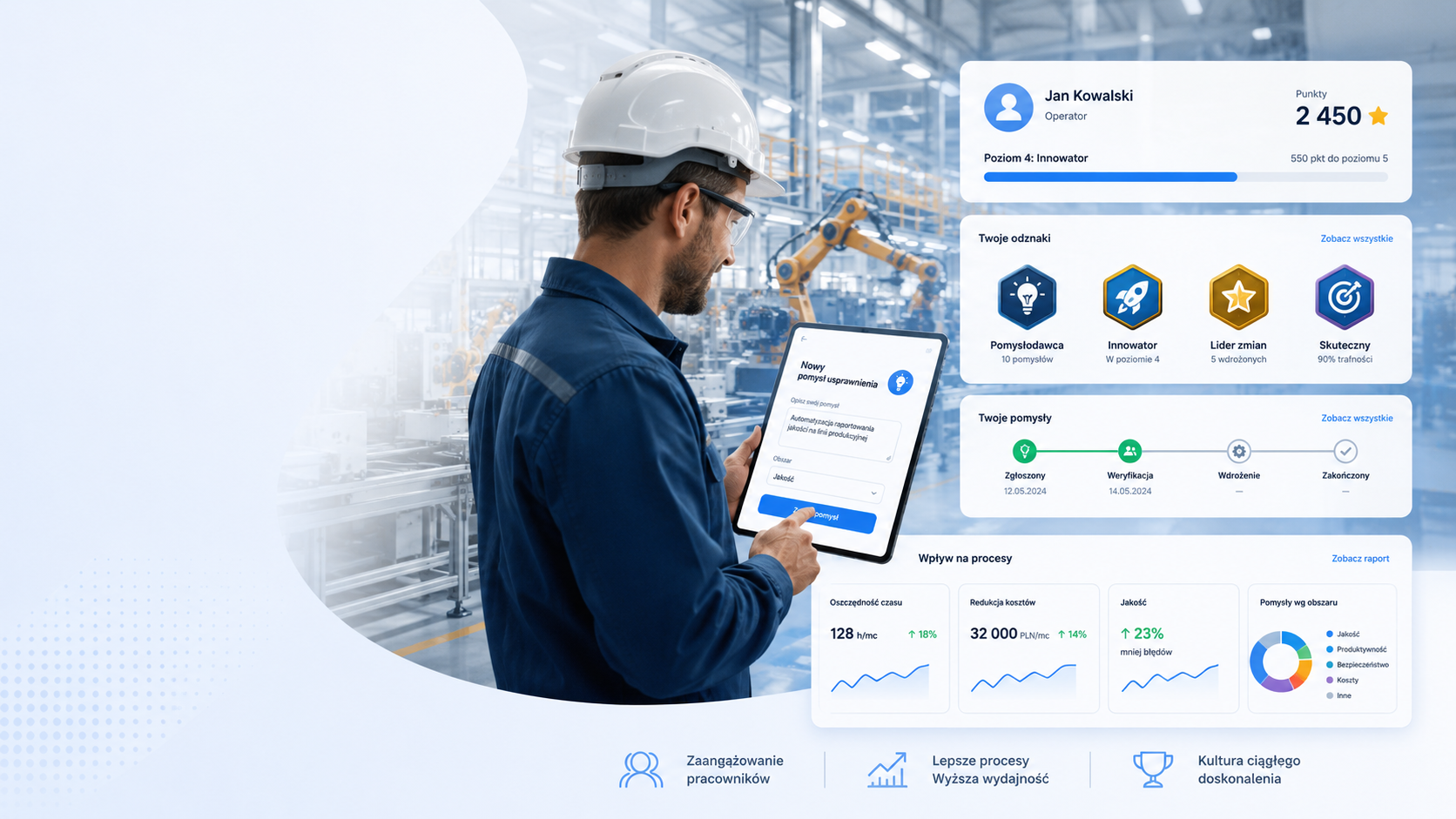
Gamification of the suggestion system is the application of game design in an industrial environment to trigger voluntary engagement among employees. This mechanism leverages the natural need for competition and recognition, translating boring form-filling into a process of gaining status and rewards.
Imagine a Monday morning on the production floor. Mr. John, instead of thinking about his third coffee, is wondering how to shorten a machine changeover by two minutes. He isn't doing this solely out of a love for process optimization. He is doing it because he is exactly twelve points short of the Efficiency Master badge, which gives him an almost mythical status in the plant hierarchy. This isn't magic; it's pure neurobiology dressed in company overalls.
Neurochemistry at the Production Line
Why would a grown adult enjoy a digital icon on a production kiosk screen? The answer lies in dopamine—the molecule that tells our brain that something very pleasant has happened. Video games have mastered this art to perfection, and we are simply borrowing their tools.
When an employee receives points for a submitted idea, their reward system activates faster than an OEE machine at full load. Research indicates that a properly designed feedback loop can increase engagement in suggestion programs by 2.5 to even 3 times. These aren't figures pulled out of thin air; they are the result of turning bureaucracy into an adventure.
Idea Retention and Hard Data
Statistics can be ruthless for traditional suggestion boxes, which usually serve as ashtrays or dust collectors. Implementing game elements changes this dynamic drastically. Idea retention—the rate of people who return with a second and third idea—grows by an average of 40 percent.
What does this mean for a production director on a Monday morning? It means that the continuous improvement process stops being a forced obligation and becomes an element of culture. People don't stop thinking about improvements after reporting one defect because the point mechanism subtly pushes them to look for further areas for optimization.
The Ranking Trap: What Could Go Wrong
A classic mistake when implementing gamification is creating a single, global ranking covering the entire company. It sounds logical, but in practice, it demotivates about 90 percent of the workforce. If Mr. John sees that the ranking leader has 5,000 points and he only has 10, the probability that he will make an effort is close to zero.
Psychology calls this the social position discouragement effect. Instead of building one giant peak that no one will climb, it is better to create a league system or periodic rankings. Otherwise, the only thing you will achieve is frustration and a sense of injustice, which is as desirable in process optimization as sand in bearings.
Badges and Status Instead of a Handshake
Material rewards are important, but status is often a stronger motivator. In biology, an individual with higher status has better access to resources. In a factory, status manifests through unique badges that are visible to others.
- Badges for specific competencies, for example, Waste Slayer or Ergonomics Guardian.
- Experience levels that unlock real privileges, such as priority in choosing vacation dates.
- Time challenges, i.e., short sprints to solve a specific technical problem.
How to Start and Not Break It
Start with small steps. A suggestion system doesn't have to immediately resemble the latest installment of a popular RPG game. Simple scoring for each submission, bonuses for team implementation of an idea, and clear visualization of progress are enough.
- Define clear scoring rules so no one feels cheated.
- Introduce rewards that matter to employees, not just to the board.
- Monitor results and react when the system starts promoting quantity over quality.
In summary, gamification is not playing at work, but a serious behavioral engineering tool. If you can make an employee feel satisfaction from every small improvement, your OEE will increase almost naturally. It's worth thinking about this before another great idea lands in the shredder of oblivion.