Kaizen vs Lean: Is Your Company a Swiss Watch or an Old Cupboard?
Lean is a strategy for waste elimination, while Kaizen is a philosophy of continuous improvement through small steps. Learn the differences and synergy of these methodologies.
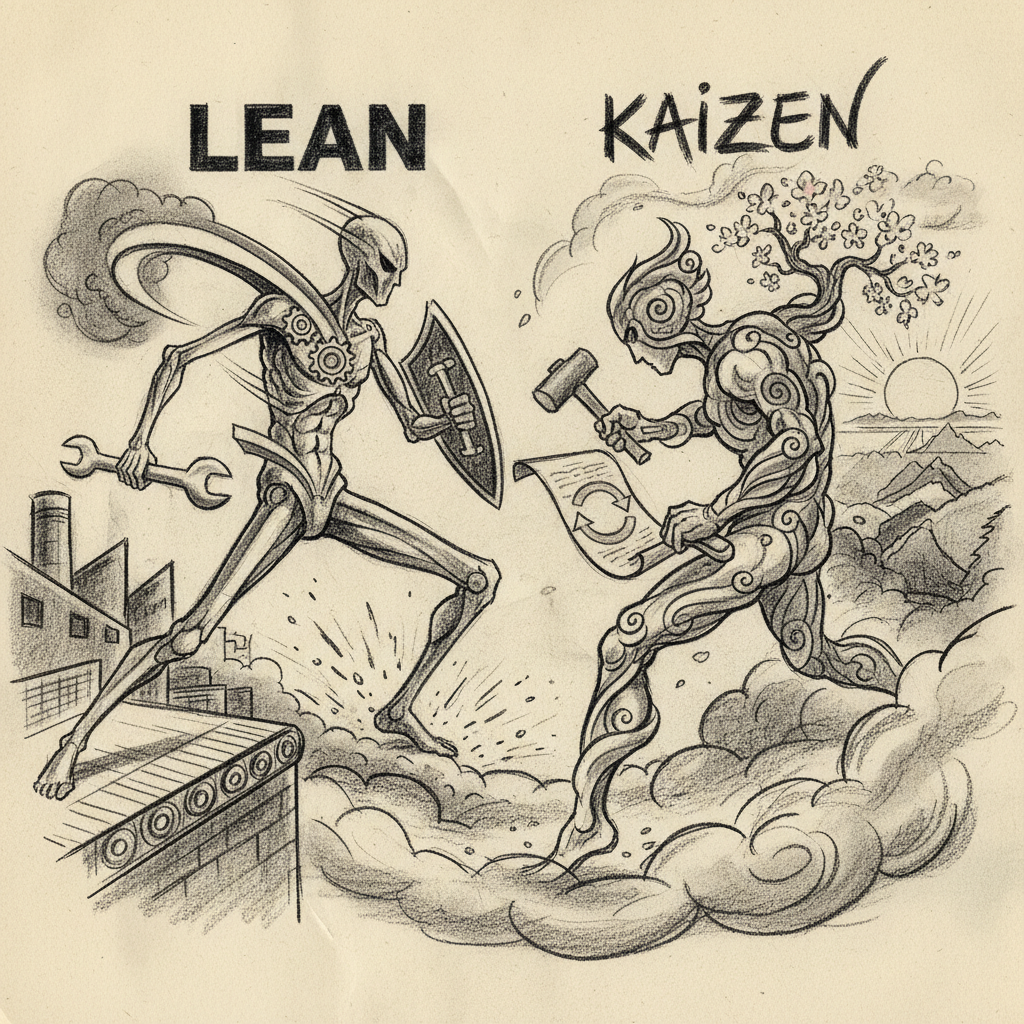
Kaizen and Lean are two pillars of modern management that are often confused as easily as chicory coffee with a real espresso. In terms of definition, Lean Manufacturing is a systemic operational strategy focused on waste elimination, while Kaizen is a philosophy of life and work based on the constant introduction of small, low-cost improvements by all employees.
Thesis: Lean is a Diet, Kaizen is a Lifestyle
Imagine that your enterprise is an organism. In this system, Lean is a rigorous weight-loss diet aimed at cutting out unnecessary fatty tissue (waste known in Japanese as Muda). Kaizen, on the other hand, is taking the stairs every day instead of the elevator. You can go on a diet and return to donuts after a month—which in the business world we call a failed ERP system implementation—but Kaizen does not let you stop. It is that nagging voice in your head saying that this Excel form could be filled out three seconds faster.
Comparative Analysis: The Scalpel vs. the Nail File
Lean Management operates at the macro level. It requires value stream mapping, identification of bottlenecks, and often a brutal reorganization of processes. This is the moment when the CFO starts nervously reviewing spreadsheets, and employees wonder if their desks will be moved forty-five degrees tomorrow in the name of ergonomics.
Kaizen works differently. It is the guerrilla warfare of efficiency. It does not require an investment budget that needs board approval for three quarters. The verification of this method happens at the very bottom of the hierarchy. If a machine operator notices that keeping a size ten wrench five centimeters closer to their left hand saves them back pain and two seconds of work, they have just performed an act of Kaizen. It is a small victory that, on an annual scale, builds the power that management theorists dream of in their glass skyscrapers.
Empirical Verification: Why Lean Without Kaizen is a Hollow Shell?
Analyzing numerous implementation cases in industry, one can reach a sad conclusion: an attempt to introduce Lean without a Kaizen mindset ends in a spectacular PR disaster. The board announces a great change, hires consultants in expensive suits who draw complex diagrams, and then everyone returns to old habits as soon as the consultants leave for the airport.
Why does this happen? Because Lean without Kaizen is dead. It is like buying the most expensive gym membership and not making any physical effort. Kaizen is that annoying but necessary consistency. It is a culture where an employee is not afraid to say that a process is senseless, and the manager does not treat it as an attack on their authority.
Digression on Waste and Human Nature
At this point, the mythical Muda must be mentioned. The Japanese identified seven main sins of waste, from overproduction to unnecessary motion. In office realities, however, the most common type of waste is a meeting that could have been an email. Lean would tell you to eliminate the meeting. Kaizen would suggest that it should at least be held standing up, which miraculously cuts discussion time in half.
Summary and Conclusions for Practitioners
Should one then choose between one or the other? Absolutely not. This is a false dichotomy. Lean provides the structure and tools (such as 5S, Kanban, or SMED), while Kaizen provides the fuel in the form of human engagement.
Key conclusions from this analysis:
- Lean is a strategic framework, Kaizen is a culture of continuous improvement.
- Lean requires capital and time commitment, Kaizen requires a change in mentality.
- Success in process optimization is achieved at the intersection of these two methodologies.
If you want your company processes to run like a Swiss watch, rather than an old cupboard that only closes when kicked in the bottom left corner, it is time to stop theorizing. Lean will show you where the mess is, but it is through Kaizen that you will learn to put things back in their place. And that is the only path to true efficiency that won't evaporate during the next economic crisis.