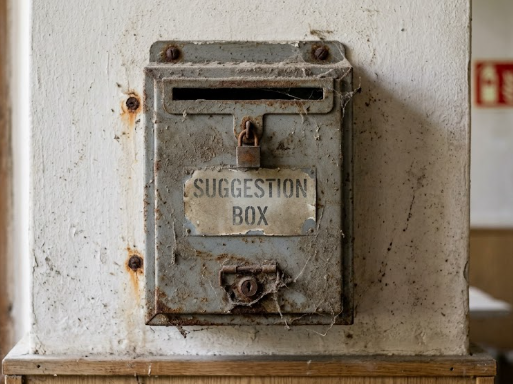
The traditional suggestion box is most often a dusty metal container that primarily serves to collect cobwebs and anonymous complaints about the quality of the coffee in the vending machine. In a modern enterprise, it is the equivalent of trying to steer a space shuttle with a wooden oar. To truly optimize processes, dead objects must be replaced with a dynamic, digital information flow that guarantees feedback and measurable KPI indicators.
The Anatomy of Failure: Why Paper Remains Silent
Imagine a Monday morning. A production line worker comes up with a brilliant idea that could reduce machine changeover time by fifteen percent. They write it down on a scrap of paper torn from a notebook and drop it into the slot of a metal box. At that moment, the idea enters a state of quantum superposition: it simultaneously exists and does not exist until someone (usually once a quarter) opens the box.
The problem is that in classical physics and operational management, time is relentless. The lack of an immediate acknowledgment of the signal kills motivation faster than free decaf coffee. The employee feels that their voice is falling into a black hole from which not even light escapes, let alone a bonus for innovation.
Statistics That Hurt More Than a Bumped Elbow
Research shows that over eighty percent of ideas dropped into physical boxes are never implemented. This is not due to bad will from management, but pure entropy. Papers get lost, handwriting is illegible, and the person responsible for analyzing them is busy putting out three other fires.
- The average response time in analog systems ranges from thirty to ninety days.
- The cost of processing one paper suggestion is four hundred percent higher than in a digital system.
- The idea retention rate (those that actually reach implementation) rarely exceeds the margin of statistical error.
Digital Evolution Instead of Rusting Sheet Metal
Instead of a box, we need an ecosystem. On Monday morning, your employee takes out their phone, takes a photo of a defect or bottleneck, and sends a suggestion through an app. The system automatically prioritizes it and assigns it to the appropriate process engineer. This isn't magic; it's simply the elimination of unnecessary friction in the information flow.
Instead of waiting for a committee to open Pandora's box, the manager sees real data on OEE and potential savings on their dashboard. This allows for decision-making based on facts, rather than whose paper happened to be at the top of the pile.
What You Gain on Monday Morning
Introducing digital suggestion management is not just a whim of the IT department. It is a concrete tool for fighting waste, which in Lean methodology we call unused employee potential.
- Transparency: Everyone sees what stage their idea is at, which builds trust.
- Gamification: You can reward quality, not just the quantity of submissions.
- Automated Reporting: Charts generate themselves while you drink that unfortunate coffee from the vending machine.
- Knowledge Archiving: Ideas are not lost during shift changes or when an employee retires.
Summary: Time for Execution
Sticking to a traditional suggestion box in the era of Industry 4.0 is like using an abacus for cryptographic calculations. You can do it, but why? Switching to a digital system allows you to turn anonymous complaining into a measurable optimization process that realistically impacts the company's financial results. If you want your employees to think like innovators, stop treating their ideas like waste paper.